Platform Monitoring using Swarm Intelligence Agents.
Hundreds of lightweight agents each watch a slice of your platform: APIs, integrations, batch jobs, queues and real user journeys. When something drifts, they converge, agree on a root cause and propose the fix. You get one page, with the answer, instead of forty alerts.
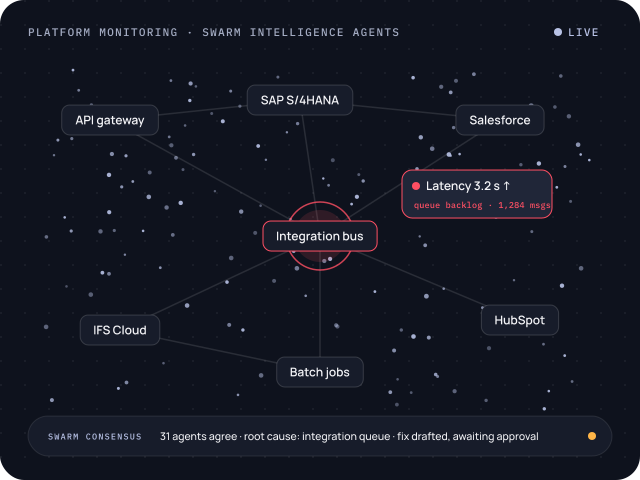
Dashboards show you that something is red. Not why, and not what to do.
Enterprise platforms fail in the gaps: a consumer stalls on the integration bus, SAP accepts the IDoc but never posts it, Salesforce reports success while HubSpot silently stops syncing. Threshold alerts fire late, all at once, and leave the diagnosis to whoever is on call.
Swarm intelligence is a different approach. Many simple agents, each with a narrow view, share signals and reinforce the ones that matter. The swarm finds the disturbance, concentrates on it and reaches a consensus about the cause, the way an ant colony finds the shortest path without any ant knowing the map.
Detect, converge, agree, fix.
Probe
Agents continuously test endpoints, queues, jobs, certificates, licences and synthetic user journeys (log in, quote, order, invoice), each at its own cadence.
Signal and converge
An agent that sees drift emits a signal. Neighbours with related views pick it up and re-probe the area, so attention concentrates where the anomaly is.
Reach consensus
Agents compare evidence (latency, error codes, queue depth, recent deployments) and vote on a root cause. One incident is opened, with the reasoning attached.
Remediate with approval
A remediation agent drafts the fix: restart a consumer, replay messages, re-route traffic, roll back a change. A person approves, or a pre-approved runbook runs on its own.
Everything between your users and your data.
Integrations and queues
Middleware, iPaaS flows, IDocs, OData and REST calls, message queues and their consumers, with end-to-end latency per message type.
Batch jobs and schedules
SAP background jobs, IFS Cloud background jobs and scheduled tasks, Acumatica schedules, Salesforce batch Apex, HubSpot workflows: did they run, did they finish, did they do what they usually do?
User journeys
Synthetic users run real flows every few minutes and time every step, so a slow quote screen is caught before the sales team notices.
Data health
Records stuck in a status, sync gaps between CRM and ERP, duplicates and orphaned references, caught as they appear.
Limits, certificates and licences
API limits, storage, expiring certificates and licences, flagged days ahead instead of on the morning they fail.
Change correlation
Deployments, configuration changes and vendor releases are logged beside the signals, so "what changed?" is answered first.
What swarm intelligence changes for the on-call engineer.
One incident, not forty alerts
Related signals are merged by the agents before anyone is paged. The page carries the suspected root cause and the evidence.
Coverage that organises itself
Agents spend more time where things are changing and less where they are stable. New endpoints and jobs are discovered and adopted.
Degrades gracefully
If some agents are blocked or a region is down, the rest keep watching. There is no single collector to lose.
Learns your normal
Baselines are learnt per job, per hour, per season. Month-end load is not an incident; a Tuesday that looks like month-end is.
Before you connect it.
Does this replace our existing monitoring tools?
It can sit on top of them. Swarm agents consume signals from Datadog, Dynatrace, Splunk, SolarWinds, Azure Monitor and vendor-native monitoring, and add synthetic journeys and cross-system reasoning on top.
Will the agents put load on our systems?
Probes are lightweight and rate-limited per system, and synthetic journeys run with dedicated test users and data. You set the cadence and the ceilings.
Can remediation run without approval?
Only for runbooks you pre-approve, such as restarting a known-safe consumer. Anything else is drafted and waits for a person. Every remediation is logged with its evidence.
Where does it run?
As a managed service, in your cloud tenancy, or both, with agents placed close to the systems they watch.