Automated Testing for the releases you don't control.
Salesforce ships three releases a year. SAP, IFS, Acumatica, HubSpot and QuickBooks all change under you. Fidevra agents build regression suites from your real processes, run them before every change and fix the tests when screens move.
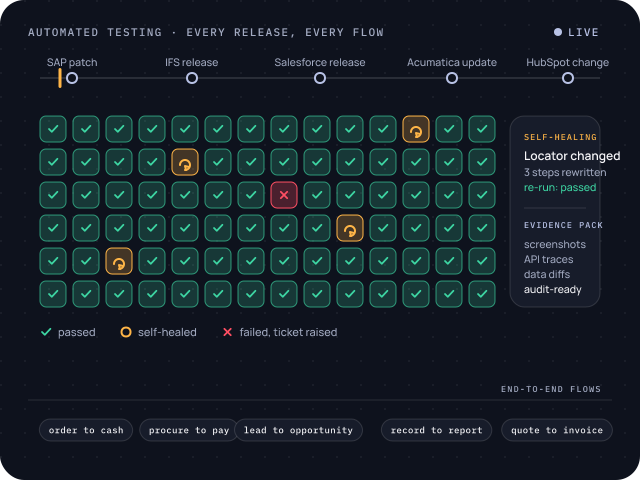
Scripted tests break the moment a vendor moves a button.
Teams either test by hand before each release, which means a few happy paths and a lot of hope, or they maintain brittle scripts that fail for the wrong reasons and get ignored. Neither catches the order that stops posting because a pricing rule changed in another system.
Fidevra tests the way your business works: end-to-end flows across systems (lead to opportunity, quote to invoice, procure to pay) driven by agents that understand the screens and APIs, recover from cosmetic changes and only raise a flag when the business outcome is wrong.
From your processes to a maintained regression suite.
Discover
Agents read your process documentation, configuration and recent transactions to map the flows that matter and the data they need.
Generate
Test cases are generated per flow with realistic data, expected results and the checks that prove the business outcome, not just that a page loaded.
Run
Suites run on a schedule, on every sandbox refresh, and when a vendor announces a release. UI and API paths are covered together.
Heal and report
When a locator or layout changes, the agent repairs the step, re-runs it and records what changed. Real failures become tickets with evidence.
Built for business systems, not just web pages.
End-to-end flows across systems
A test can start as a HubSpot deal, become a Salesforce opportunity, an IFS customer order and an SAP invoice, and check every hop.
Self-healing steps
Renamed fields, moved buttons and new layouts are recognised and repaired automatically; the change is logged for review.
Data-aware assertions
Tests check ledger balances, stock levels, pipeline values and document statuses, so a passing test means the business result is right.
Release-triggered runs
Salesforce release previews, SAP support packs, IFS Cloud release updates, Acumatica upgrades and HubSpot changes trigger the suite before they hit production.
Load and performance checks
Critical journeys are timed every run, so a slow quote screen is caught as a regression, not as a complaint.
Evidence packs
Screenshots, API traces and data diffs per test, bundled per release for change control, SOX and ISO audits.
The flows most teams start with.
Each one is a template the agents adapt to your configuration and data.
- Lead to opportunity
Capture, assignment, conversion, pipeline stages and forecasting in Salesforce or HubSpot.
- Quote to invoice
Pricing, discounts, approvals, order creation and invoicing across CRM and ERP.
- Procure to pay
Requisition, PO, receipt, invoice matching and payment in SAP, IFS, Acumatica or QuickBooks.
- Order to cash
Order entry, availability, delivery, billing and cash application, including EDI and portal orders.
- Record to report
Journals, allocations, period close and the reports your finance team signs.
- Integrations
The middleware, iPaaS flows and custom connectors between all of the above.
Before your next release.
Do we have to write test scripts?
No. Agents generate the cases from your processes and data, and you review them in plain language. Your team can add, edit or retire tests in the same way.
Will tests touch production data?
Tests run in sandboxes, test tenants or against masked data by default. Read-only production probes are available for monitoring, and anything that writes needs explicit approval.
How does self-healing avoid hiding real bugs?
Healing is limited to how a step is performed (finding a moved field, a renamed button), never to what is checked. If the expected business result is not met, the test fails and a ticket is raised with the evidence.
Does it work with our existing tools?
Results and tickets flow into Jira, Azure DevOps and ServiceNow. Existing Selenium, Playwright or Provar suites can be imported and maintained by the agents.