Supply Chain Intelligence Center: know the risk behind every supplier and customer.
An ERP-agnostic intelligence module that gives finance, compliance and supply chain teams continuous visibility into the companies they do business with. It sits alongside IFS Cloud, SAP S/4HANA, Oracle ERP Cloud, Microsoft Dynamics 365, NetSuite, Infor and others, reads the external signals an ERP cannot see, and turns them into one scored risk profile per entity.
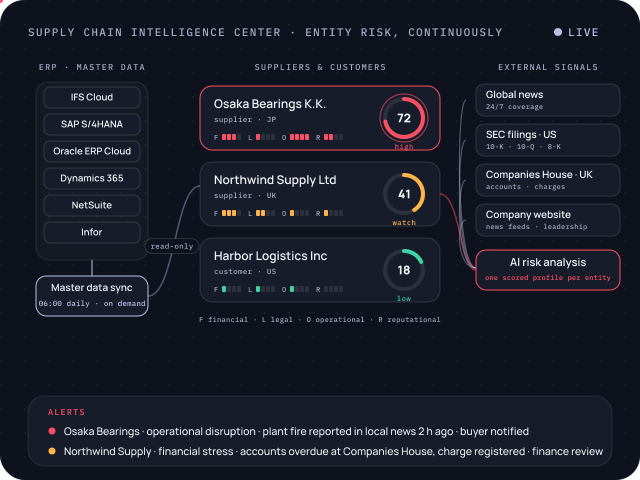
Your ERP knows what you bought and what you sold. It cannot see what is happening to the companies on the other side.
A supplier files overdue accounts, loses a key customer, or has a fire at its only plant. A customer is named in a lawsuit, changes its leadership twice in a quarter, or quietly stops paying everyone else first. None of that appears in a supplier or customer master record, and by the time it shows up as a missed delivery or an unpaid invoice, the damage is done.
The Supply Chain Intelligence Center is an external intelligence layer that sits alongside your ERP. It synchronises your supplier and customer master data without replacing or modifying the ERP, then continuously gathers and analyses the outside signals (news, regulatory filings, company registries, the companies' own websites) so your teams see risk as it develops, ranked by what is at stake for you.
Connect, onboard, monitor, alert.
Connect and synchronise
Supplier and customer master data is synchronised from IFS Cloud, SAP S/4HANA, Oracle ERP Cloud, Dynamics 365, NetSuite, Infor or any other system on a scheduled or on-demand basis. Read-only; nothing in the ERP is replaced or modified.
Onboard entities
Each supplier and customer becomes a monitored entity, matched to its legal identity and registry records, with your own exposure (spend, open receivables, open orders) attached from the ERP.
Gather external signals
The platform continuously collects what an ERP cannot see: global news coverage, SEC filings in the US, Companies House records in the UK, and each company's own website and news feeds.
Score and alert
AI analysis consolidates the sources into a single scored risk profile per entity and raises an alert whenever a supplier or customer shows signs of financial stress, legal exposure, operational disruption or reputational damage.
One scored risk profile for every company you depend on.
ERP-agnostic connectors
IFS Cloud, SAP S/4HANA, Oracle ERP Cloud, Microsoft Dynamics 365, NetSuite, Infor and others, plus file and API imports for anything else. One module, every ERP in the group.
Continuous external monitoring
Entities are watched around the clock, not screened once at onboarding. New filings, registry changes, press coverage and website changes are picked up as they appear.
Four risk dimensions
Each profile scores financial stress, legal exposure, operational disruption and reputational damage separately, then as one overall score, with the evidence linked to every change.
Alerts ranked by exposure
A score change on a supplier you spend millions with outranks the same change on a one-off vendor. Alerts reach the right owner in the Center, by email or in Teams.
Onboarding and compliance
Screen a new supplier or customer before it is created in the ERP, keep a dated evidence trail for every review, and re-screen on a schedule your compliance policy sets.
Portfolio views
Risk across the whole supplier base and customer book: by category, country, business unit, spend and open receivables, so concentration and exposure are visible at a glance.
What the platform reads that your ERP cannot.
Sources are added as coverage grows. Every alert links back to the source it came from.
- Global news coverage
Mainstream, trade and local press in multiple languages: closures, incidents, layoffs, acquisitions, disputes and sanctions mentions.
- SEC filings in the US
10-K, 10-Q and 8-K filings for listed companies: going-concern language, material litigation, leadership changes, restatements.
- Companies House records in the UK
Overdue accounts, newly registered charges, officer resignations, strike-off and insolvency notices.
- The company's own website and news feeds
Leadership announcements, site closures, product changes and anything that disappears from the site.
- Your own exposure, from the ERP
Spend, open payables and receivables, open orders and delivery history, so every score is weighed against what it would cost you.
One intelligence layer, three teams.
Finance
Protect working capital. See customer risk before credit is extended or an order is released, and supplier risk before prepayments and long-term commitments.
Compliance and procurement
Strengthen supplier onboarding with a scored, evidenced review, re-screen on schedule, and answer "what did we know and when" from the audit trail.
Supply chain
Surface disruption at a supplier weeks before it reaches your line, and identify single points of failure across the supplier base while there is still time to dual-source.
What the first quarter looks like.
Problems surface before they reach the supply chain
The plant fire, the overdue accounts and the lawsuit arrive as alerts with evidence, not as a missed delivery three weeks later.
Working capital is protected
Credit decisions and prepayments are made against a live risk profile instead of last year's financials.
Onboarding and compliance get stronger, not slower
Every new supplier and customer is screened and evidenced in minutes, and re-screened without anyone remembering to.
The ERP stays exactly as it is
No new fields, no modified workflows, no migration. The Center reads master data and sits alongside.
Before you connect it.
Does it change anything in our ERP?
No. The Center synchronises supplier and customer master data on a schedule you set, or on demand, using read-only access. It never replaces or modifies ERP records. If you later want risk flags written back to the ERP, that is an optional, separately approved step.
Which ERPs are supported?
IFS Cloud, SAP S/4HANA, Oracle ERP Cloud, Microsoft Dynamics 365, NetSuite and Infor out of the box, and any other system through its API or a scheduled file export. Groups running several ERPs get one consolidated view.
Where do the risk signals come from?
Global news coverage, SEC filings in the US, Companies House records in the UK, and each company's own website and news feeds, with further registries and sources added as coverage grows. Every alert links to the source it was derived from.
How are the scores produced?
AI analysis reads the sources for each entity, classifies what it finds into financial stress, legal exposure, operational disruption and reputational damage, and consolidates it into one scored profile with the evidence attached. You set the thresholds and who is alerted for each dimension.
How quickly is it useful?
Connect read-only and the first scored profiles for your top suppliers and customers are typically available within two weeks. Alerting, onboarding workflows and portfolio views follow within the 30-day pilot.