The Agentic Platform for SAP, IFS, Salesforce, HubSpot, Acumatica and QuickBooks.
One agent core that reads and writes in the systems your business runs on, follows your approval rules and explains every action it takes. Describe the job; Fidevra does the work.
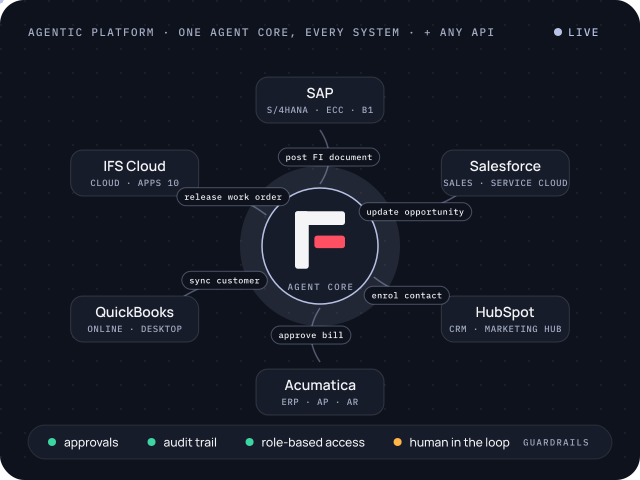
Your systems hold the truth. Your people still carry it between them by hand.
A won deal in Salesforce becomes a customer in Acumatica, an order in SAP, an invoice in QuickBooks and a thread of emails asking whether it shipped. Each hop is a person re-keying, checking and chasing. Copilots that only summarise don't change that; the work still has to be done in the system of record.
Fidevra agents are built to do that work. They hold scoped credentials, call the platforms' own APIs, respect the roles and workflows you already configured, and stop to ask when a rule says a person must decide.
What the platform gives every agent.
The capabilities below are shared by every Fidevra product, so a second or third use case takes days, not a new project.
Native connectors
SAP S/4HANA, ECC and Business One, IFS Cloud and IFS Applications 10, Salesforce, HubSpot, Acumatica, QuickBooks Online and Desktop, Microsoft 365, Google Workspace, and any REST, OData or MCP endpoint.
Jobs in plain language
Brief an agent the way you would brief a new hire: inputs, rules, what good looks like. Fidevra turns it into a tested agent with the right tools and limits.
Approvals and segregation of duties
Amount thresholds, role checks and four-eyes rules are enforced by the platform, not by each prompt. Agents request; the right person approves in email, Teams or Slack.
Audit trail by construction
Every read, write, decision and the evidence behind it is recorded and queryable in plain language. "Show every PO this agent approved over 50k and why" is a one-line question.
Multi-agent orchestration
Specialist agents (finance, sales ops, IT) hand work to each other with structured hand-offs, and can be asked to disagree before a decision is made.
Model-agnostic, deploy anywhere
Use your preferred model provider or an open model. Run Fidevra as a managed service or inside your own cloud tenancy with your keys and your data residency.
What agents do in each system.
Examples of jobs that run today. Every connector exposes the platform's own objects and actions, so the list grows with your briefs.
SAP S/4HANA · ECC · Business One
Post FI documents, create and release purchase orders, maintain vendor and customer master data, clear open items, run and read reports, process IDoc and OData errors, draft month-end accruals from source transactions.
IFS Cloud · IFS Applications 10
Create and release purchase orders and customer orders, register supplier invoices with PO matching, maintain parts, customers and suppliers, raise and update work orders and service requests, and act on IFS Cloud projection (REST) and event data.
Salesforce
Enrich and route leads, keep opportunities honest (stages, close dates, next steps), convert won deals into ERP customers and orders, triage and enrich cases from ERP data, maintain products and price books.
HubSpot
De-duplicate and enrich contacts and companies, enrol records into sequences and workflows by rule, sync deals and quotes to the ERP, reconcile marketing-sourced pipeline with invoiced revenue.
Acumatica
Create AP bills and AR invoices, release and apply payments, manage sales orders and shipments, maintain customers and vendors, run generic inquiries and act on exceptions.
QuickBooks Online · Desktop
Enter and match bills, categorise transactions, chase overdue invoices with approved templates, reconcile vendor statements, prepare clean books for the accountant.
Email, Teams, Slack and the rest
Agents read the inbox, portals and shared mailboxes where work actually arrives, and ask for approvals where people already are. Anything with an API can be added as a tool.
Every run follows the same loop.
Trigger
A schedule, an inbound email, a webhook from Salesforce or HubSpot, or a person asking in chat.
Gather and reason
The agent reads the relevant records across systems, checks them against the rules in its brief and decides what to do.
Act or ask
Within its limits it writes to the system of record. Outside them it packages the evidence and asks the right person to approve.
Record and report
Reasoning, evidence and results are logged. Dashboards show touchless rate, exceptions and cycle time per job.
Enterprise controls from day one.
Agents get the least access needed for the job, and nothing they do is invisible.
- Scoped service accounts
Each agent uses its own credentials with the minimum roles in SAP, IFS, Salesforce, HubSpot, Acumatica or QuickBooks. Revoke one agent without touching the rest.
- Single sign-on and role-based access
SSO for the people who brief, approve and review. Roles decide who can change a brief, raise a limit or see a log.
- Your data stays yours
No customer data is used to train models. Choose where the platform runs and where logs are stored.
- Kill switch and rate limits
Pause any agent or every agent in one click. Per-agent limits on actions per hour and on amounts stop a bad brief from becoming a bad day.
Things people ask before a pilot.
Do we need to change anything in SAP, IFS, Salesforce or the other systems?
No. Fidevra uses each platform's supported APIs and your existing roles and workflows. You create a service account per agent with the permissions the job needs, and nothing else changes.
What happens when an agent is unsure?
It stops and asks. Every brief defines what the agent may do alone and what needs approval. Anything outside the brief, or any check that fails, becomes an exception with the evidence attached and an owner.
Which AI models does the platform use?
The platform is model-agnostic. You can use your preferred provider, an open model, or a mix per job. Model calls can run inside your own cloud tenancy so data never leaves it.
How long does a first agent take?
A typical pilot connects one or two systems and runs one queue (for example, late purchase orders or won-deal hand-offs) within 30 days, with success metrics agreed before we start.
Can we build our own agents on the platform?
Yes. Your team can write and version briefs, add tools and connectors, and promote agents from sandbox to production with the same guardrails our own products use.